
The Story Behind the Song
“Love (Can Make You Happy)” by Mercy
One of the prettiest love ballads to come out of the late 60s was a one-hit wonder called, “Love (Can Make You Happy),” by the group ‘Mercy.’ The song was released in April of 1969 and quickly reached #2 on the Billboard Hot 100 Chart.
The first question that comes to mind after researching this is how can one simple little one-hit wonder song have such a history?
It all started around 1968 when Jack Sigler, Jr. formed a band while a senior in high school in Tampa, Florida. He named the band, Mercy. Members came and went until he settled on Brenda McNish, Debbie Lewis, Ronnie Caudill, Ann Sigler, John Hudson, Roy Schultz and Lou Vasenda. They played the usual area dances and parties from Tampa to Miami.
Later in ’68, a company came to town to film a movie, called ‘Fireball Jungle.’ Jack’s father knew the movie’s producer, George Rober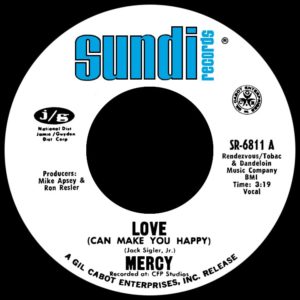 ts, and had him come listen to Mercy. Roberts liked them and decided to include them somewhere in the film. He asked them if they had a good original song and Jack said he had one that he had written while still in high school, called “Love (Can Make You Happy)”.
When the movie producer heard them sing it, he decided to use it in the film. The movie was “Fireball Jungle” and was terribly written, produced and acted. It co-starred Lon Chaney, Jr. toward the end of his career. It was a racing, gangster ridden, sexploitation filled extravaganza, complete with LSD references. Mercy had a scene in a bar standing in a corner lip-syncing, “Love (Can Make You Happy).” How anyone thought that this song would fit this movie is beyond me. The finished movie did not screen well (shocking!) and was never released for national distribution. Clips of it can be found on YouTube.
Mercy’s lead guitarist, Ronnie Caudill also wrote a fuzzy, distorted instrumental for the movie called (what else, “Fire Ball”. It would become the B-side of Mercy’s record, when released, but it was only him on the song, even though the record showed the artist as Mercy.
Gil Cabot owned a local record label called Sundi and had a list of forgettable records which he had released. When he heard Mercy’s song, he approached the band to release it which they did. Sigler’s father put up the cash for the band to record the song and Cabot released it on the Sundi label.
Around this time, Sigler joined the Navy and Mercy broke up. Meanwhile, the record was making good regional airplay. So much so that Cabot made a deal with Jamie/Guyden Records of Philadelphia for national distribution. The song hit the Billboard Hot 100 in April of 1969 and soon soared to #2 for two weeks. It could not push those pesky Beatles out of the #1 slot with “Get Back.”
With the song’s success, Cabot wanted an album. But Mercy had broken up with Sigler in the service, so he decided to create another group. He called them ‘The Mercy,’which he thought was different enough from the original group name, but that the public wouldn’t noti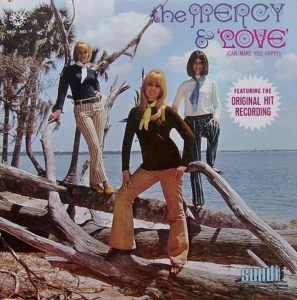 ce the difference. He still owned the original song, “Love (Can Make You Happy),” so it was included on the album. The album cover proudly boasted the fact that it contained the original hit song (which it did). The rest of the songs were covers of other popular songs and were recorded by person’s unknown. Rumor has it that it was a trio consisting of Cabot’s wife and two others including possibly his secretary. The album cover picture was of three girls who people assumed were Mercy. No one knows if they were the actual singers. Most likely, they were only models for the cover. Cabot also had to come up with a group for touring to help push the album, which he did, probably the same trio of singers used on the album. Backing instruments were widely acknowledged to be by Mighty Manfred and the Wonder Dogs, a local band who had recently recorded a single for Sundi. For obvious reasons, the Caudill song, “Fire Ball,” was not included on this album.
Now is when the story really gets interesting. In mid-1969, Sigler came home on leave to find that an album which Mercy had nothing to do with was about to be released and a fake group was touring under the ‘Mercy’ name. While Cabot at Sundi did still own “Love (Can Make You Happy),” he did not own the ‘Mercy’ name and Sigler had not signed with him to do an album, especially with other singers.
Sigler filed a lawsuit, but in the meantime, reformed Mercy. Members changed a little, but returning to the band were Brenda McNish, Ronnie Caudill and Debbie Lewis. New members were James Marvell, Buddy Good and Rodger Fuentes.
Sigler, with his new band, signed with Marlin Productions, whose head, Henry Stone, arranged for the group to sign with Warn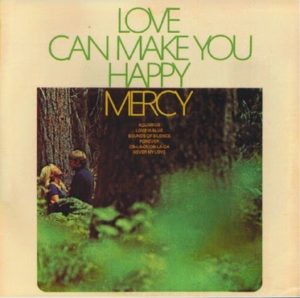 er Bros. Warner Bros had the group quickly record an album to collide with the Sundi release. This album, however, would feature the real group, although modified from the lineup on the single release, who actually recorded their own songs.
Since Sundi still owned the original “Love (Can Make You Happy)” recording, it could not be included on the Warner Bros LP. Therefore, Sigler had the band re-record the song as closely as possible to the original and that version was put on the new album.
The two albums were released about the same time in June of 1969. They were both titled, “Love (Can Make You Happy).” Sundi’s LP hit the charts first, but by the second week Billboard only listed the Warner Bros LP. This continued until falling off the charts completely. Obviously, the Warner Bros LP, alternate version of the hit song and all, outsold the Sundi version. Not sure if Billboard, at the time, knew about the conflict. After litigation on Sigler’s lawsuit, the Sundi LP was eventually banned from any further release.
Warner Bros also released the alternate version of “Love (Can Make You Happy)” overseas as a single in June. Ironically, the Japanese picture sleeve of that version pictured three women vaguely resembling the Sundi’s album cover.
Warner Bros was in the driver’s seat as well when it came to a follow-up single because Sundi did not have one unless they wanted to release a single by the tour group, whic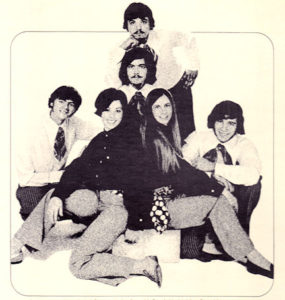 h they chose not to do because of the legal entanglements.
“Forever” from the Warner Bros album, was released in June and went to #79 on the Billboard Hot 100 and #24 on the Easy Listening chart. It was a remake of the ‘Little Dippers’ hit from 1960. Another, non-album, single “Hello Baby” went nowhere. It’s B-side, “Heard You Went Away,” had been included on the LP.
As soon as the Warner Bros LP recording sessions had been done, Sigler had to return from leave to the Navy. He didn’t even have time to be included in the band’s publicity photo. By the time he had ended his military service and returned home, Warner Bros had dropped the band after the last single failed and because Sigler was still in the service at that time and Mercy had all but broken up, so he had no group to return to.
Even this doesn’t end the saga. As late as 1996, there was a lawsuit between Cabot and Jamie/Guyden Records concerning the national distribution of “Love (Can Make You Happy).” The court ruled that the statute of limitations had run out on some of Cabot’s complaints. There was a lot of back of forth concerning royalty payments an d record keeping. Cabot had, in fact, received money in other deals outside of the agreement, so the case was dismissed.
Jack Sigler recorded the 1993 album, ‘Influences,’ and put together a new four-member group called ‘Jack Sigler & Mercy’ to tour in 2005.
The current group continues to tour to this day.
____________________________________________________________________________________________________
Who wrote the song on flip side of Mercy “I Just Want To See You
Hi, Does anyone know if Ann Sigler was Jack’s sister?
I don’t know, but I will ask him.
Jack Sigler Jr not only a great song writer but one of the nicest people I know. Glad to see your still breathing Jack your old buddy Erv Shuemake
Yes he is a very nice person. I will let him know you were asking about him…
hi I was in the 5th and 6th grade with gil cabot after school we would lip sink to our fav songs. I remember that gil would always pick something from the platter. gil was always promoter’s promoter. great classic song!